On January 1st, 1892, Ellis Island began operating as a processing centre for those arriving on the shores of America. It continued in this way until 1954, where it saw over 12 million people enter the country as immigrants throughout its time in use. Those who made the long journey from Ireland did so to make a new life for themselves, spurred on by the dire economic situation that persisted in their homeland throughout the 19th century, and in desperate search of the ever-elusive American Dream. There is no doubt that folklore travelled with those who emigrated to America, as evidenced by how big an affair St Patrick’s Day and Halloween remain in the States even today (these events will be explored in a further post). However, the journey to America, and particularly Ellis Island, also began rooted in folklore with a traditional community based custom, that is both celebratory and mournful in nature, and is unique only to Ireland; The American Wake.
The American Wake
Sometimes called a ‘live wake’ or ‘bottle night’, the American wake served as a departure ritual for the young men and women who were leaving Ireland in droves throughout the 19th and early 20th centuries. Grace Neville, a professor who has worked at both University College Cork and University College Dublin throughout her long career, reveals how there is a need to mark important life events that exists on a cross-cultural level. Neville gives examples such as birth and marriage and reveals that orthodox religion, at some point, took over many of the milestones celebrated by communities as part of their traditional customs. [1] In terms of death as a life event, the Irish have a long-standing custom of holding a wake before a funeral service is given. At the wake, family and friends usually gather at the home of the deceased, whose body is present, in order to commemorate the life of the person who is about to depart the earthly plain forever. There is some speculation as to how exactly the wake originated in Ireland and other Celtic countries, with some believing it to be a pagan survival that was adopted by the Catholic church. This would, of course, fit in with Nevilles assertion that religious groups often take over the traditional rituals and customs of communities, in order to assimilate ideologies into one cohesive belief system.
Mourning the Living
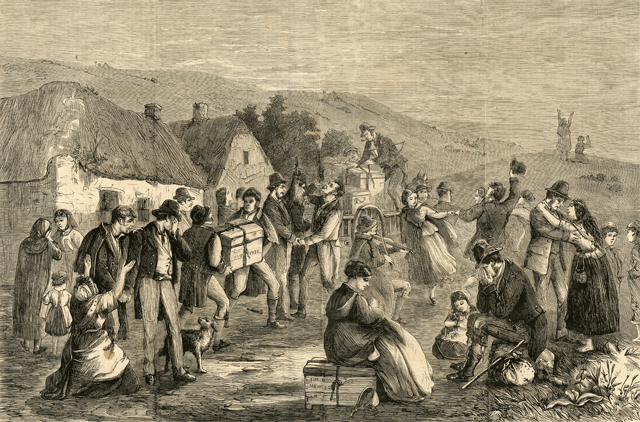
So if wakes are held only for the dead, why is the American wake held for the living? Quite simply, the families of Irish emigrants believed they would never see their departing relatives again; migration to American acted as a sort of death to those who left, as well as those who stayed behind, who were left mourning the loss of a loved one to a new world. Though obviously sad affairs, the American wake was usually quite a lively one too. Eileen Metress points out that ‘death and emigration freed one forever from the stark hopelessness of poverty’, [2] which explains why the sombre occasion was marked also with gaiety and celebration.
The key elements of the American wake revolved around music, dancing, and drink, and were organised by the whole town or village in which they were taking place. Everybody had their role; some would be responsible for providing the alcohol, while others would supply food or tobacco for the wake, or as gifts for person who was leaving to take with them on their long journey. This community responsibility was greatly received by some poorer families who may otherwise have struggled to put on a wake for their loved one. Though not as jovial, American wakes were still put on in times of great poverty during The Great Famine, showing the importance placed on the ritual and what it meant to the individual leaving, as well as the wider community.
A typical American wake would begin at sundown, after the emigrant had called round to all in their community who were not able to attend, to let them know that they were soon to be leaving and say their goodbyes. The event would last until sunrise, with the time in between being filled with ballad singing, jigs and heavy drinking. The ballads were usually quite sombre in nature, detailing the loss experienced by those left behind, yet also encouraged optimism in those who were leaving. Some of the songs told of the hardship the emigrants would face upon reaching America, which alleviated some of the guilt that they would have felt from leaving their families behind. The ballad ‘Poor Pat Must Emigrate’ by A. W Auner perfectly encapsulates the torn emotions felt by those venturing out of the boundaries of their homeland, a transcript of which can be found here. All who were physically able took part in the dancing, which itself became emboldened with melancholy as more alcohol was consumed and the evening wore on. Metress notes the following observation of a dance taking place between a father and son;
‘each one trying as never before to make it a jig to remember, there would not be a dry eye in the house. The partnership they expressed in their timing, the ascendancy of their concentration over their sorrow, and the note of courage and hope in their exuberance, brought what everyone was feeling to the surface and broke down all restraints’ [3]
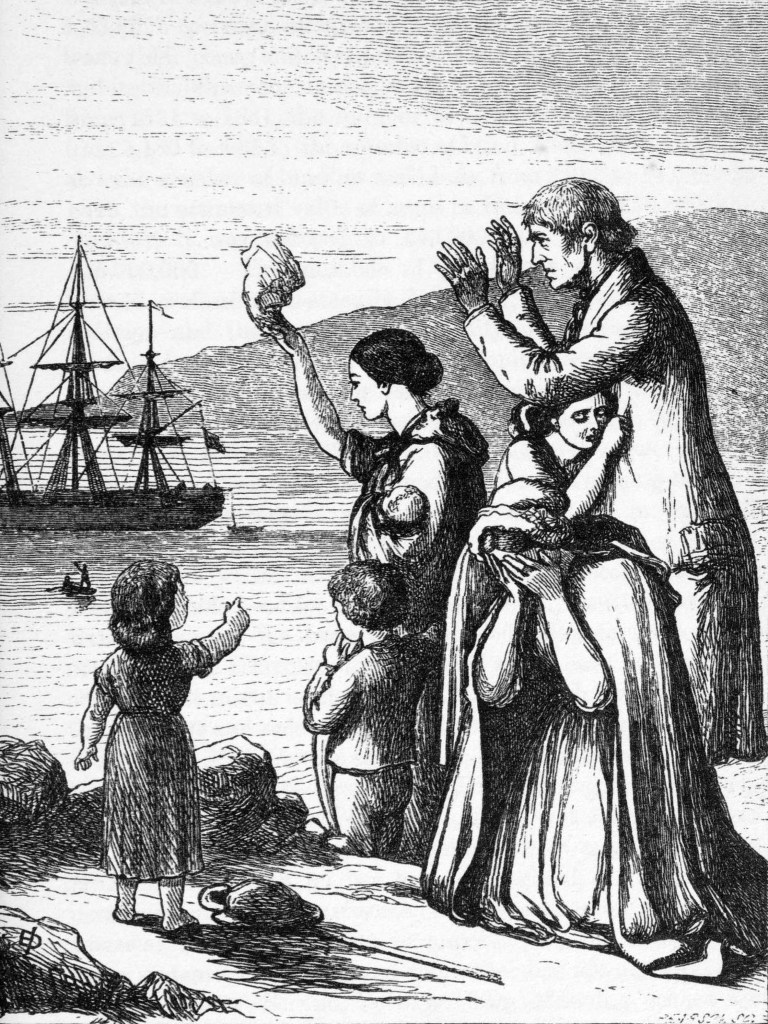
Upon sunrise, the wake would come to an abrupt end. Confronted with the sobering light of dawn, the emigrant would be escorted to their place of departure by younger friends and family members, in what was termed as a convoy. The convoy would see their emigrant friend to the nearest train station or dock, bid them good luck, and say one final goodbye. The emigrant, now alone, would then continue their onward journey towards a new life where hope and prosperity had been promised.
The ritualisation of the emigrants departure, with the main elements of the custom comprising mostly of dancing, music, and drink, saw the coming together of communities in order to bid final farewells, that transformed the practice into a folklore tradition in its own right. This has inspired a wave of music production that centres on music about folklore, with many Irish music artists detailing the American wake and more general migration in the songs. The Irish most definitely took their folklore to America, and were seemingly aided by the fact that their journey also started with it. Folklore became and remained their ties to home, a place many of the 19th century Irish emigrants would never see again.
Further Reading
1- Grace Neville, ‘Rites de passage. Rituals of separation in Irish oral tradition’ in Charles Fanning (ed.), New Perspectives on the Irish Diaspora (Illinois, 2000), pp 117-30 (117)
2 – Eileen Metress, “The American Wake of Ireland: Symbolic Death Ritual.” OMEGA – Journal of Death and Dying 21, no. 2 (October 1990): 147–53 (148)
3 – Eileen Metress, “The American Wake of Ireland: Symbolic Death Ritual.” OMEGA – Journal of Death and Dying 21, no. 2 (October 1990): 147–53 (151)

 Folklore Celebrations and the Irish Diaspora