Probably one of the most recognisable celebrations that belong to Ireland and its wider diaspora is St Patrick’s Day. Observed on 17th March each year, the day serves as both a religious feast day and cultural commemoration, marking the accepted date that the patron saint of Ireland is believed to have died. Born in 5th century Britain and well before he was a saint, Patrick was captured by Irish raiders and taken to Ireland to live as a slave at the age of 16, where he did for 4 years. He escaped back to Britain after receiving a message from God, who told Patrick that a ship was ready for him to take him home. After returning to Britain, Patrick then received another message in a dream, described by Patrick himself who chronicled the dream in his own memoir. According to the many churches dedicated to Saint Patrick, he wrote;
“I saw a man coming, as it were from Ireland. His name was Victoricus, and he carried many letters, and he gave me one of them. I read the heading: ‘The Voice of the Irish.’ As I began the letter, I imagined in that moment that I heard the voice of those very people who were near the wood of Foclut, which is beside the western sea-and they cried out, as with one voice: ‘We appeal to you, holy servant boy, to come and walk among us.’”
This dream led Patrick to study for priesthood and after many years he became ordained and returned to Ireland, where he would spend the rest of his life in his attempts at converting to island to Christianity. He was, however, largely forgotten not so long after his death. It wasn’t until the end of the 7th century that Patrick fell back into popularity and into legendary status, at this time becoming recognised as patron saint of Ireland. Since then, copious amounts of folklore have grown out of the legend of Saint Patrick, all of which inform contemporary Saint Patrick’s Day celebrations, which have reached global status thanks to the far reach of the Irish diaspora.
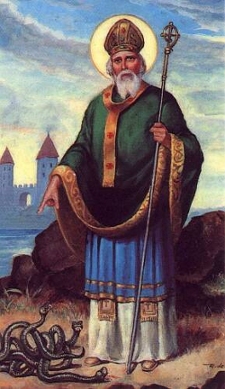
The Folkloric Associations of Saint Patrick’s Day
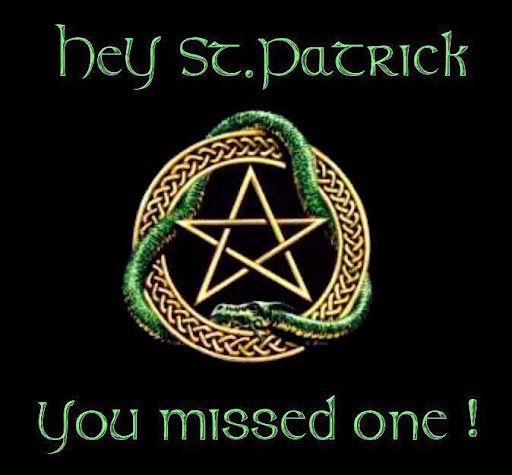
The most commonly held folkloric belief surrounding Saint Patrick rests on his demonstrated ability to drive the snakes from Ireland. Regardless of whether Ireland had any snakes to begin with or not, this is a legend that has endured many centuries since it came into popular belief. This has been interpreted as symbolic, with the snakes being representative of the Irish paganism and druidry that Saint Patrick drove out of Ireland through the success of his missionary exploits. Recently, this interpretation has swept the on and offline neo-pagan community, with some staunchly objecting to partaking in Saint Patrick’s Day celebrations, especially in the USA where paganism has gained an immense following in recent years.

The shamrock is also central to the lore of Saint Patrick and his national/international day. Many believe that Saint Patrick used the three-leaf shamrock to demonstrate the concept of the Holy Trinity to those he was trying to convert. Frank Thorne accepts that the folklore surrounding the shamrock may be the only thread that holds some truth in a vast array of myths and legends related to Saint Patrick. [1] However, he also notes that the ancient Gaeilge word for shamrock is ‘seamróg’, which means any three-leaf plant, so could just as easily refer to the clover, which Ireland has many other folkloric associations with pertaining to luck. Nevertheless, the shamrock has been used as a prominent symbol during global Saint Patrick’s Day celebrations, yet appears to now be interchangeable with the clover. The plants feature mostly in parade costumes, as well as on the dress of those who partake in the celebration from a public standpoint. This can be found in the form of pin badges, fabric print, and even novelty sunglasses, all donned by revellers enjoying the days indulgent festivities. Having said that, the use of the shamrock remains a more low-key affair in Ireland. Instead of gaudy outfits and novelty items, those observing Saint Patrick’s Day in Ireland instead wear a cluster of shamrocks that have been blessed by a local priest on their right breast. This demonstrates how Irish folklore has been changed and adapted by the wider Irish diaspora in order to suit their chosen folkloric celebratory expression.
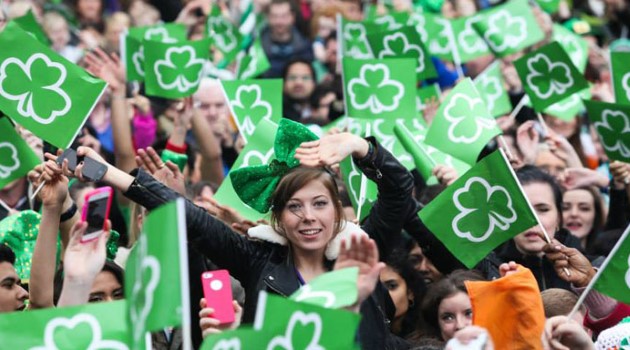
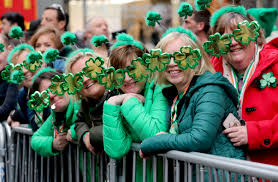
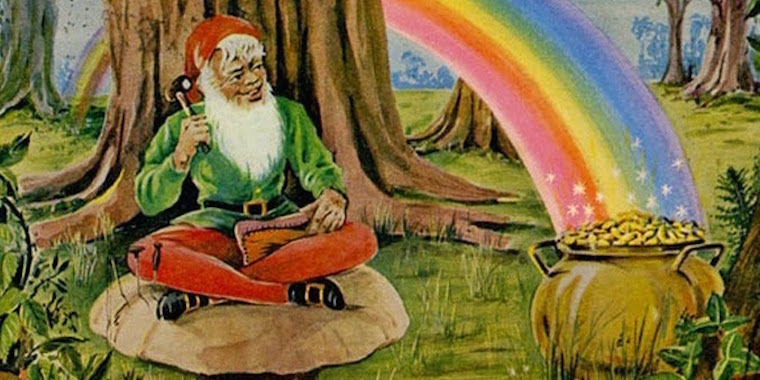
As you can see from the above images, green also features prominently in the celebrations. There are many theories surrounding this phenomenon, with a definitive answer yet to be given. One theory relates to the shamrock, itself being green in colour, and it’s long-running use of denoting Irishness. Another tells of the relationship being green and the leprechaun; a member of the Aos Sí in Irish folklore who is thought to grant 3 wishes to humans if they are captured, and are heavily featured in Saint Patrick’s Day celebrations around the world. It is the latter that reveals how Irish folklore has, again, been adapted to suit not only the beliefs and traditions of the Irish diaspora, but also their economic situation. If you attend a Saint Patrick’s Day celebration outside of Ireland and ask a stranger why they are wearing green, they will likely tell you that it’s so they can blend in amongst the fairies. If you’re not wearing green when you ask the question, you’re also likely to be pinched. This is because many believe that mischievous fairies, including leprechauns, take part in the days festivities. Green has been heralded as the colour of the fairies outside of Ireland for centuries, so wearing clothing of the same colour is said to spare you from their trickery. However, as revealed by John Hutchings, fairies in Ireland traditionally wore red. [2] It has been suggested that green became the chosen colour of Irish migrants because it was easier and cheaper to dye clothing in emerald hues than it was to dye them red.
Contemporary Saint Patrick’s Day Celebrations
Much like the American Wake discussed in my previous post, the ritualisation of Saint Patrick’s Day amongst the Irish diaspora has seen it transform into folklore itself. However, the relationship goes beyond Irish emigration to America and can instead be seen the world over. Some of the less surprising places where the day is marked in a big way – due to historic voluntary migration and forced transportation – are England, Australia and New Zealand. More surprising is the annual Saint Patrick’s Day parade that has been put on in Tokyo by the Japanese government since 1992. Celebrations are also observed in Argentina, Norway, and Croatia, amongst many others. The ways that each country celebrates are consistent across the board, with costume, dancing, singing, food, and drink all being central to the occasion. The day, along with its associated folklore, is observed by all members of the Irish diaspora, showing the impact that Irish migration has had on the folkloric celebrations of a global community.
Further reading
1 – Thone, Frank. “Nature Ramblings: Shamrocks and Snakes.” The Science News-Letter 25, no. 675 (1934): 175. Accessed January 8, 2020. doi:10.2307/3909933.
2 – Hutchings, John. “Folklore and Symbolism of Green.” Folklore 108 (1997): 55-63. Accessed January 8, 2020. http://www.jstor.org/stable/1260708.

 Folklore Celebrations and the Irish Diaspora