Blog Feed

O ’tis a fearful thing to be no more; Or if to be, to wander after death – Halloween and the Irish Diaspora

The above line, taken from John Dryden and Nathaniel Lee’s poem ‘From Oedipus’, perfectly encapsulates the eerie spookiness that surrounds Halloween, celebrated throughout the world on October 31st. A holiday that some refer to as a modern American invention, Halloween is actually a lot older than most realise, with it’s origins stemming from Ireland and ancient Celtic culture. In it’s original incarnation as the Gaelic holiday of Samhain, the celebration acted as a festival to mark the end of the harvest and transformation of the seasons in to the darker half of the year. The festival was observed from October 31st to November 1st and included a feast. In a much similar fashion to the Mexican Dia de Muertos, which falls at a similar time of year, it was believed that the souls of the dead were able to walk among the living during the festivities. So much so, that places would be set at the feast table so that the dead could dine with their living relatives. With the Christianisation of Ireland, Samhain was replaced by All Saints and All Souls Day, with the religious festival evolving into Halloween through commercialisation of the holiday.
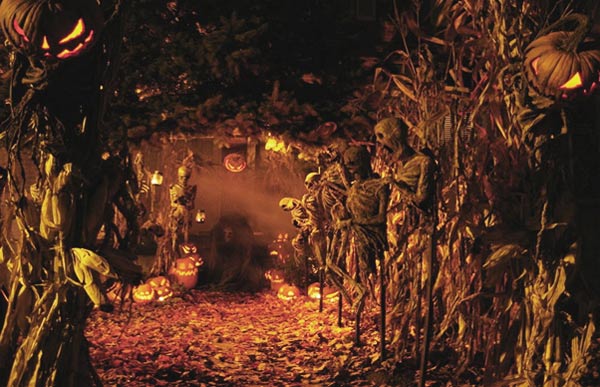
Visualisation of Samhain

Though a globally observed holiday, it is America where Halloween is celebrated in the grandest fashion, aided by the folklore transported by the Irish who migrated to the States during the 18th and 19th centuries. It is thanks to Irish folklore that some of the most recognisable aspects of Halloween exist.

Halloween Traditions based on Irish Folklore

The classic pumpkin, or Jack O Lanthern, carved with a scary face and lit from the inside with a candle, is a mainstay of modern Halloween tradition. The original Jack O Lantern was made by carving a turnip and placing a candle inside, inspired by the Irish folktale of Stingy Jack. Stingy Jack is known for tricking the devil by having him turn into a silver coin when Satan came to collect his soul. Jack struck a deal with the devil that saw him receive 10 more years before he had to depart to hell. After the 10 years passed and Satan returned once more to collect him, Jack tricked him again and the devil eventually agreed that he would never take him into hell. Upon Jack’s death, he tried to make his way to heaven and was refused due to the sinful life he led. He begged Satan to let him into hell but the devil refused to take his soul. Instead, he gave Jack an ember to carry with him as a warning to others not to play games with the devil. According to Irish folklore, Stingy Jack has since walked the plane between heaven and hell, doomed to an eternity without peace, carrying his ember inside a hollowed turnip. The pumpkin, being more readily available in America than the turnip, was adopted by Irish migrants within the States. The candle inside the pumpkin is thought to ward off evil spirits, and usually acts as an invitation for trick’or’treaters.
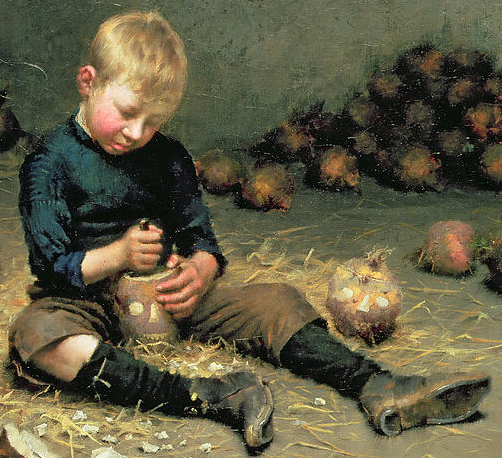
A young boy carves a turnip

Dressing up, or guising, is also practised at Halloween. Those observing the holiday tend to dress themselves in elaborate and supernaturally themed costumes, the most common in the contemporary period being witches, werewolves and vampires. Contemporary Halloween tradition has seen an increase in costumes related to popular culture, with the characters from recent blockbusters featuring during the festivities in the year of their release. The custom of dressing up is based on the Celtic belief that the dead can cross-over during the Halloween season, as well as the belief that the Aos Sí, Irelands fairy race, are up to their old tricks during this time. Disguising oneself in costume was thought to keep you safe from interference from both the dead and the Aos Sí for the duration of the festive period. Though great effort is put into modern costume during Halloween, especially in America, it is the older and more simple designs that inspire the most fear…

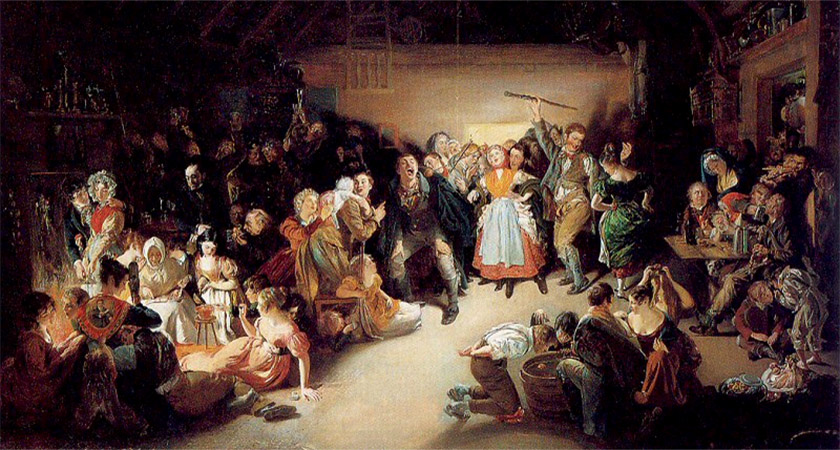
At any Halloween party you are likely to find people participating in apple bobbing. In the past, it was common for young people to participate in the game, and the first person able to grab the stalk between their teeth and retrieve an apple was said to be the next to marry. In Ireland, the game is referred to as Snap Apple, where it is also believed that placing a bobbed apple beneath your pillow will enable you to dream of a future sweetheart. Sometimes, instead of apples being placed in water, they would instead be tied on a string and hung from the ceiling, but the rules of the game remained the same. On the island of Newfoundland and Labrador, which saw up to 35,000 Irish migrants arrive between the late 17th and early 19th centuries, Halloween is referred to as Snap Apple Night. This is yet another clear example of how folklore travelled with Irish migrants and became embedded into the cultural celebrations of their newly settled land.
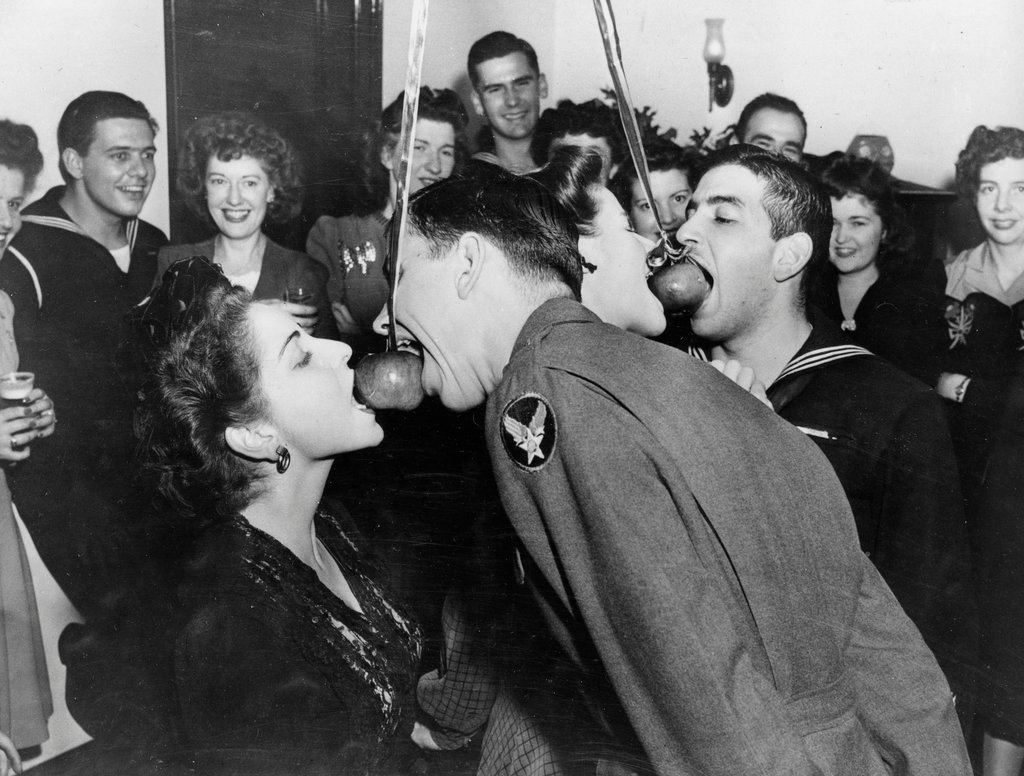
A New York Halloween party in 1943

Conclusions

By studying the folklore of Irish migrants, it is possible to trace the ways that traditions and beliefs are carried with those who undertake the journey to a new land. Folklore allows for new insights on the aspects of social history that are too often overlooked when looking at the history of migration. Instead of just providing figures and statistics about who went where, we are able to paint a more cohesive picture of the cultural and social experience of migrants. This approach does not just apply to Ireland and it’s diaspora, but to all cultural and ethnic diasporas that exist around the world, whichever way they chose to identify. Folklore is the story of the people it belongs to and holds an unrivalled ability to integrate itself into new cultures, as well evolve in line with the lived experiences of those who carry it with them, wherever they may end up.
We Appeal to You, Holy Servant Boy, to Come and Walk Among Us – St Patrick’s Day and the Irish Diaspora

Probably one of the most recognisable celebrations that belong to Ireland and its wider diaspora is St Patrick’s Day. Observed on 17th March each year, the day serves as both a religious feast day and cultural commemoration, marking the accepted date that the patron saint of Ireland is believed to have died. Born in 5th century Britain and well before he was a saint, Patrick was captured by Irish raiders and taken to Ireland to live as a slave at the age of 16, where he did for 4 years. He escaped back to Britain after receiving a message from God, who told Patrick that a ship was ready for him to take him home. After returning to Britain, Patrick then received another message in a dream, described by Patrick himself who chronicled the dream in his own memoir. According to the many churches dedicated to Saint Patrick, he wrote;

“I saw a man coming, as it were from Ireland. His name was Victoricus, and he carried many letters, and he gave me one of them. I read the heading: ‘The Voice of the Irish.’ As I began the letter, I imagined in that moment that I heard the voice of those very people who were near the wood of Foclut, which is beside the western sea-and they cried out, as with one voice: ‘We appeal to you, holy servant boy, to come and walk among us.’”

This dream led Patrick to study for priesthood and after many years he became ordained and returned to Ireland, where he would spend the rest of his life in his attempts at converting to island to Christianity. He was, however, largely forgotten not so long after his death. It wasn’t until the end of the 7th century that Patrick fell back into popularity and into legendary status, at this time becoming recognised as patron saint of Ireland. Since then, copious amounts of folklore have grown out of the legend of Saint Patrick, all of which inform contemporary Saint Patrick’s Day celebrations, which have reached global status thanks to the far reach of the Irish diaspora.

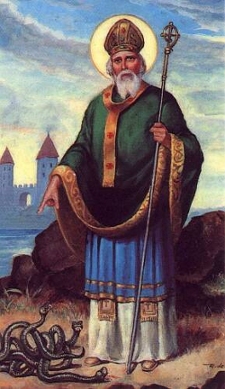
Saint Patrick

The Folkloric Associations of Saint Patrick’s Day

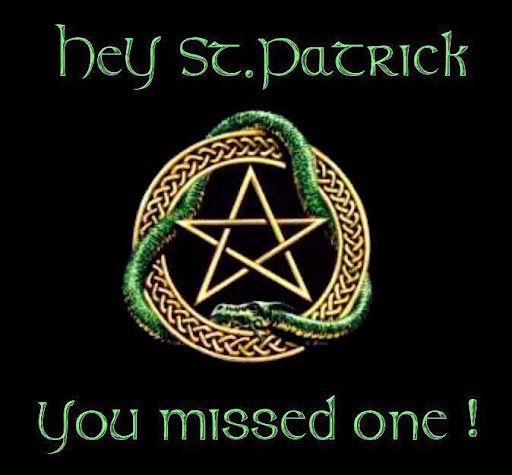
The most commonly held folkloric belief surrounding Saint Patrick rests on his demonstrated ability to drive the snakes from Ireland. Regardless of whether Ireland had any snakes to begin with or not, this is a legend that has endured many centuries since it came into popular belief. This has been interpreted as symbolic, with the snakes being representative of the Irish paganism and druidry that Saint Patrick drove out of Ireland through the success of his missionary exploits. Recently, this interpretation has swept the on and offline neo-pagan community, with some staunchly objecting to partaking in Saint Patrick’s Day celebrations, especially in the USA where paganism has gained an immense following in recent years.

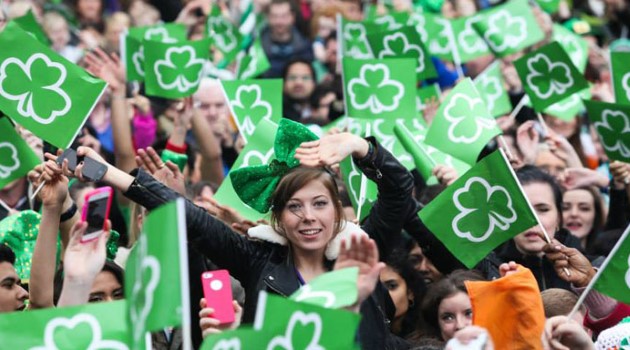
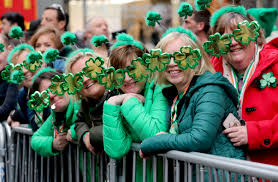
The shamrock is also central to the lore of Saint Patrick and his national/international day. Many believe that Saint Patrick used the three-leaf shamrock to demonstrate the concept of the Holy Trinity to those he was trying to convert. Frank Thorne accepts that the folklore surrounding the shamrock may be the only thread that holds some truth in a vast array of myths and legends related to Saint Patrick. [1] However, he also notes that the ancient Gaeilge word for shamrock is ‘seamróg’, which means any three-leaf plant, so could just as easily refer to the clover, which Ireland has many other folkloric associations with pertaining to luck. Nevertheless, the shamrock has been used as a prominent symbol during global Saint Patrick’s Day celebrations, yet appears to now be interchangeable with the clover. The plants feature mostly in parade costumes, as well as on the dress of those who partake in the celebration from a public standpoint. This can be found in the form of pin badges, fabric print, and even novelty sunglasses, all donned by revellers enjoying the days indulgent festivities. Having said that, the use of the shamrock remains a more low-key affair in Ireland. Instead of gaudy outfits and novelty items, those observing Saint Patrick’s Day in Ireland instead wear a cluster of shamrocks that have been blessed by a local priest on their right breast. This demonstrates how Irish folklore has been changed and adapted by the wider Irish diaspora in order to suit their chosen folkloric celebratory expression.

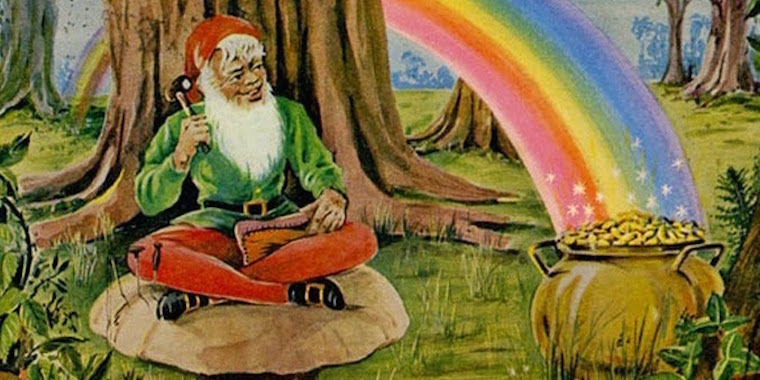
As you can see from the above images, green also features prominently in the celebrations. There are many theories surrounding this phenomenon, with a definitive answer yet to be given. One theory relates to the shamrock, itself being green in colour, and it’s long-running use of denoting Irishness. Another tells of the relationship being green and the leprechaun; a member of the Aos Sí in Irish folklore who is thought to grant 3 wishes to humans if they are captured, and are heavily featured in Saint Patrick’s Day celebrations around the world. It is the latter that reveals how Irish folklore has, again, been adapted to suit not only the beliefs and traditions of the Irish diaspora, but also their economic situation. If you attend a Saint Patrick’s Day celebration outside of Ireland and ask a stranger why they are wearing green, they will likely tell you that it’s so they can blend in amongst the fairies. If you’re not wearing green when you ask the question, you’re also likely to be pinched. This is because many believe that mischievous fairies, including leprechauns, take part in the days festivities. Green has been heralded as the colour of the fairies outside of Ireland for centuries, so wearing clothing of the same colour is said to spare you from their trickery. However, as revealed by John Hutchings, fairies in Ireland traditionally wore red. [2] It has been suggested that green became the chosen colour of Irish migrants because it was easier and cheaper to dye clothing in emerald hues than it was to dye them red.

Traditional Irish leprechaun in green and red

Contemporary Saint Patrick’s Day Celebrations

Much like the American Wake discussed in my previous post, the ritualisation of Saint Patrick’s Day amongst the Irish diaspora has seen it transform into folklore itself. However, the relationship goes beyond Irish emigration to America and can instead be seen the world over. Some of the less surprising places where the day is marked in a big way – due to historic voluntary migration and forced transportation – are England, Australia and New Zealand. More surprising is the annual Saint Patrick’s Day parade that has been put on in Tokyo by the Japanese government since 1992. Celebrations are also observed in Argentina, Norway, and Croatia, amongst many others. The ways that each country celebrates are consistent across the board, with costume, dancing, singing, food, and drink all being central to the occasion. The day, along with its associated folklore, is observed by all members of the Irish diaspora, showing the impact that Irish migration has had on the folkloric celebrations of a global community.

Further reading
1 – Thone, Frank. “Nature Ramblings: Shamrocks and Snakes.” The Science News-Letter 25, no. 675 (1934): 175. Accessed January 8, 2020. doi:10.2307/3909933.
2 – Hutchings, John. “Folklore and Symbolism of Green.” Folklore 108 (1997): 55-63. Accessed January 8, 2020. http://www.jstor.org/stable/1260708.

Last Call for Ellis Island – Leaving for America

On January 1st, 1892, Ellis Island began operating as a processing centre for those arriving on the shores of America. It continued in this way until 1954, where it saw over 12 million people enter the country as immigrants throughout its time in use. Those who made the long journey from Ireland did so to make a new life for themselves, spurred on by the dire economic situation that persisted in their homeland throughout the 19th century, and in desperate search of the ever-elusive American Dream. There is no doubt that folklore travelled with those who emigrated to America, as evidenced by how big an affair St Patrick’s Day and Halloween remain in the States even today (these events will be explored in a further post). However, the journey to America, and particularly Ellis Island, also began rooted in folklore with a traditional community based custom, that is both celebratory and mournful in nature, and is unique only to Ireland; The American Wake.

‘Ellis Island’ by Mary Black, 1985

The American Wake

Sometimes called a ‘live wake’ or ‘bottle night’, the American wake served as a departure ritual for the young men and women who were leaving Ireland in droves throughout the 19th and early 20th centuries. Grace Neville, a professor who has worked at both University College Cork and University College Dublin throughout her long career, reveals how there is a need to mark important life events that exists on a cross-cultural level. Neville gives examples such as birth and marriage and reveals that orthodox religion, at some point, took over many of the milestones celebrated by communities as part of their traditional customs. [1] In terms of death as a life event, the Irish have a long-standing custom of holding a wake before a funeral service is given. At the wake, family and friends usually gather at the home of the deceased, whose body is present, in order to commemorate the life of the person who is about to depart the earthly plain forever. There is some speculation as to how exactly the wake originated in Ireland and other Celtic countries, with some believing it to be a pagan survival that was adopted by the Catholic church. This would, of course, fit in with Nevilles assertion that religious groups often take over the traditional rituals and customs of communities, in order to assimilate ideologies into one cohesive belief system.

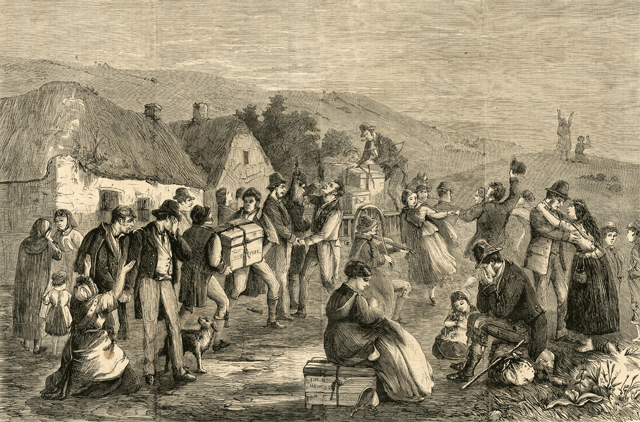
An American Wake

Mourning the Living

So if wakes are held only for the dead, why is the American wake held for the living? Quite simply, the families of Irish emigrants believed they would never see their departing relatives again; migration to American acted as a sort of death to those who left, as well as those who stayed behind, who were left mourning the loss of a loved one to a new world. Though obviously sad affairs, the American wake was usually quite a lively one too. Eileen Metress points out that ‘death and emigration freed one forever from the stark hopelessness of poverty’, [2] which explains why the sombre occasion was marked also with gaiety and celebration.

The key elements of the American wake revolved around music, dancing, and drink, and were organised by the whole town or village in which they were taking place. Everybody had their role; some would be responsible for providing the alcohol, while others would supply food or tobacco for the wake, or as gifts for person who was leaving to take with them on their long journey. This community responsibility was greatly received by some poorer families who may otherwise have struggled to put on a wake for their loved one. Though not as jovial, American wakes were still put on in times of great poverty during The Great Famine, showing the importance placed on the ritual and what it meant to the individual leaving, as well as the wider community.

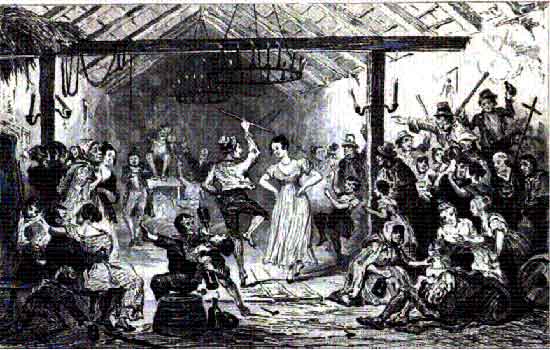
A typical American wake would begin at sundown, after the emigrant had called round to all in their community who were not able to attend, to let them know that they were soon to be leaving and say their goodbyes. The event would last until sunrise, with the time in between being filled with ballad singing, jigs and heavy drinking. The ballads were usually quite sombre in nature, detailing the loss experienced by those left behind, yet also encouraged optimism in those who were leaving. Some of the songs told of the hardship the emigrants would face upon reaching America, which alleviated some of the guilt that they would have felt from leaving their families behind. The ballad ‘Poor Pat Must Emigrate’ by A. W Auner perfectly encapsulates the torn emotions felt by those venturing out of the boundaries of their homeland, a transcript of which can be found here. All who were physically able took part in the dancing, which itself became emboldened with melancholy as more alcohol was consumed and the evening wore on. Metress notes the following observation of a dance taking place between a father and son;

each one trying as never before to make it a jig to remember, there would not be a dry eye in the house. The partnership they expressed in their timing, the ascendancy of their concentration over their sorrow, and the note of courage and hope in their exuberance, brought what everyone was feeling to the surface and broke down all restraints’ [3]

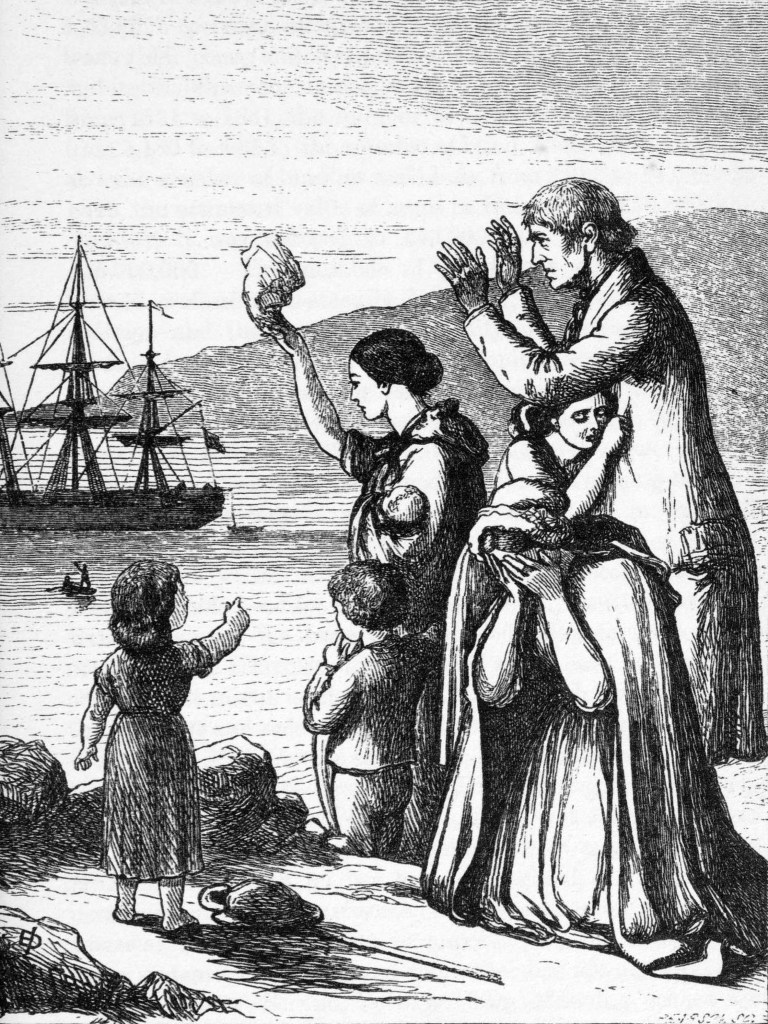
Upon sunrise, the wake would come to an abrupt end. Confronted with the sobering light of dawn, the emigrant would be escorted to their place of departure by younger friends and family members, in what was termed as a convoy. The convoy would see their emigrant friend to the nearest train station or dock, bid them good luck, and say one final goodbye. The emigrant, now alone, would then continue their onward journey towards a new life where hope and prosperity had been promised.

‘American Wake’ by The Elders, 2004

The ritualisation of the emigrants departure, with the main elements of the custom comprising mostly of dancing, music, and drink, saw the coming together of communities in order to bid final farewells, that transformed the practice into a folklore tradition in its own right. This has inspired a wave of music production that centres on music about folklore, with many Irish music artists detailing the American wake and more general migration in the songs. The Irish most definitely took their folklore to America, and were seemingly aided by the fact that their journey also started with it. Folklore became and remained their ties to home, a place many of the 19th century Irish emigrants would never see again.

Waving Goodbye

Further Reading
1- Grace Neville, ‘Rites de passage. Rituals of separation in Irish oral tradition’ in Charles Fanning (ed.), New Perspectives on the Irish Diaspora (Illinois, 2000),  pp 117-30 (117)
2 – Eileen Metress, “The American Wake of Ireland: Symbolic Death Ritual.” OMEGA – Journal of Death and Dying 21, no. 2 (October 1990): 147–53 (148)
3 – Eileen Metress, “The American Wake of Ireland: Symbolic Death Ritual.” OMEGA – Journal of Death and Dying 21, no. 2 (October 1990): 147–53 (151)

The Irish Diaspora

Ireland has an incredibly long migrational history, beginning with those who travelled to England and Scotland during the early medieval period, and continuing in the present day where Irish emigrants can be found in even the most far-flung corners of the world. There are an estimated 35 million members of the Irish diaspora currently living in the USA, 600,000 in England, and 7000 ‘first generation’ Irish in the UAE; to give just a small snapshot of the global reach of this specific migrational group. The Department of Foreign Affairs and Trade in Ireland (DFA) define the global Irish diaspora as follows;

’emigrants from Ireland and their descendants around the world and those with a tangible connection to Ireland. This is not static. The degree of awareness of Ireland among the diaspora may fluctuate from time to time. Some people may have the heritage, but neither the interest nor knowledge. Interest can be prompted by major external events, by changes in circumstance or by chance’

Based on the definition given by the DFA, and how Ireland itself views its own global citizens, it is quite difficult to provide absolute statistics on how many Irish people are living in a certain place at any given time. It is no longer possible to denote ‘Irishness‘ that is hinged solely on being born in Ireland, having Irish citizenship, or by being in possession of other legal documentation; anyone with Irish ancestry can claim to fully encompass Irishness, and are very much encouraged to do so by the Irish government.

What is Irishness?

Since Irishness has entered into abstract meaning, it can become a challenge when wanting to explain exactly what it means to feel or be Irish. However, this is where folklore comes in to lend a guiding hand. With its defining features of customs, stories, traditions, and beliefs that belong to a community passed down through generations by word of mouth, folklore provides an insight into Irishness around the world by enabling us to look at the ways that Irish heritage is celebrated and recognised within the global diaspora. In any mass-migration, it is not just the people that travel. They take their traditions and beliefs with them. Sometimes they go to great effort to conserve traditions and beliefs in actuality, other times traditions and beliefs are allowed to evolve to fit in with new lands and communities. In all cases, folklore moves with the people it belongs to. This can come in the form of food, music, religion, and even dress; anything that can be transmitted along the migrational journey in either a physical or more intangible form. As such, this blog will examine the ways in which Irish traditions and beliefs migrated with those who left Ireland to seek new pastures, by examining Irish celebratory culture, in both its joyous and – sometimes – more sorrowful forms.

Snap Apple Night by Daniel Maclise, Blarney, 1833.